.png "HistorSTL — STL Files for 3D Printing Historical Miniatures: Warriors & Military Models")
Death of Prince Sviatoslav at the Dnieper Rapids: Causes, Battle Conditions and the Balance of Forces with Khan Kurya
After the difficult war with Byzantium, Sviatoslav was forced in 971 to make peace after the siege of Dorostolon and abandon his positions on the Danube. In other words, he was returning home not at the head of an army at the height of its strength, but after a campaign that had seriously reduced his resources and freedom of action. Studies of the Balkan campaigns note that after his defeat he moved back up the Dnieper and was killed near the rapids on his return journey in the spring of 972.
.jpg)
Sviatoslav died not because of one single mistake, but because of a combination of strategic exhaustion, poor logistics, a predictable route, and an underestimation of the Pechenegs. At the same time, it is important to distinguish what the sources state directly from later historical reconstruction.
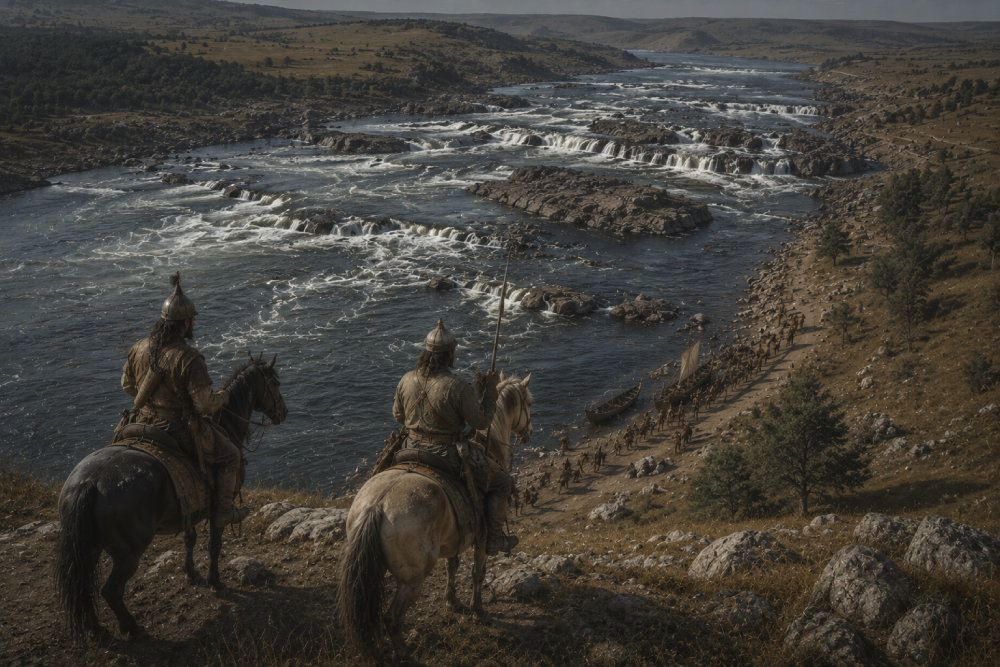
The most dangerous part of the route was the Dnieper Rapids. For a river-borne force, they formed a natural bottleneck: boats could not simply sail through every section, and at certain points the Rus had to slow down, unload, or move along the riverbank. This gave the Pechenegs, who were highly experienced in steppe warfare and cavalry operations, a major tactical advantage. Byzantine tradition, already in the time of Constantine VII, emphasized that the Pechenegs were particularly capable of attacking the Rus in the area of the Dnieper Rapids.
A key point is that Sviatoslav knew about the danger. The chronicle tradition says that his commander Sveneld advised him not to go through the rapids and instead return by another route, but Sviatoslav rejected the advice. Even if this detail is treated cautiously, the logic of the events itself shows that the route was predictable and potentially controlled by the Pechenegs.
Logistics were even more important. Sviatoslav was unable to continue home immediately and was forced to spend the winter near the mouth of the Dnieper. In the chronicle account, this wintering was accompanied by a severe shortage of food. After such a winter, the army was almost certainly much weaker: the men were exhausted, horses and supplies were limited, and some weapons or possessions may have been lost or exchanged for food. By spring, Sviatoslav was therefore in a very difficult position: he had to move, even if the route was dangerous.
This is where Kurya's tactics probably came into play. The Pechenegs did not need to defeat Sviatoslav in a major open battle. It made far more sense to wait where his force would lose its mobility. A mounted steppe detachment could observe the approaches, choose the right moment, and attack while part of the Rus force was occupied with crossing or hauling boats. This is a reconstruction, but it fits the geography and what is known about Pecheneg control of the steppe routes.
There is also the famous theory of a Byzantine connection. After the peace of 971, Emperor John I Tzimiskes was indeed engaged in diplomacy with the Pechenegs; studies of the Pechenegs' political role note a renewal of Byzantine-Pecheneg relations during this period. Some sources and historical works interpret this as possible Byzantine encouragement of action against Sviatoslav.
However, I would not present the claim that “Byzantium ordered Sviatoslav's assassination” as an established fact. His death was extremely advantageous to Tzimiskes, but diplomatic contact with the Pechenegs by itself does not prove that there was a direct order to kill the prince.
There was another major strategic weakness in Sviatoslav's position: his political and military system depended too heavily on the prince himself and his retinue. He was an exceptionally active military ruler, but his campaigns from Khazaria to Bulgaria stretched his sphere of operations across an enormous distance. The farther he moved from Kyiv, the more dependent he became on long lines of communication along the Dnieper and across the steppe. After his defeat in the Balkans, this system effectively collapsed: there was no reserve army capable of clearing his road home, no secure corridor, and the prince himself had been cut off from his main resource base.
So I would rank the causes of his death as follows: first, strategic and logistical vulnerability after the war with Byzantium; second, the choice of a dangerous and predictable route through the rapids; third, an effective Pecheneg ambush; and only after that, the possible diplomatic role of Byzantium.
The irony is that Prince Sviatoslav of Kyiv, who had won throughout much of his life through speed, initiative, and mobility, died precisely when he had lost all three advantages. At the rapids he was forced to follow a known route with an exhausted retinue against an enemy that could choose both the place and the moment of battle. In this sense, his death looks less like a random catastrophe and more like the logical outcome of the extremely risky strategy of the final years of his reign.
Why Didn't He Turn Back and Take Another Route Later?
Because “turning back and going around” was probably much harder in his situation than it appears on a modern map. The sources do not explain Sviatoslav's thoughts, so from this point onward we can only speak about the most plausible reconstruction.
The main point is that Sviatoslav had already effectively retreated from the rapids once. According to the chronicle tradition, in the autumn he approached the dangerous section, realized that the Pechenegs controlled the passage, and could not break through. As a result, he stayed for the winter in the area of Beloberezhye. Its exact location remains debated, although it is usually associated with the lower Dnieper and the coast of the Dnieper-Bug estuary. In other words, he had already made the decision “not to go through right now” — but during the winter the situation became worse rather than better: severe hunger set in and the retinue lost strength.
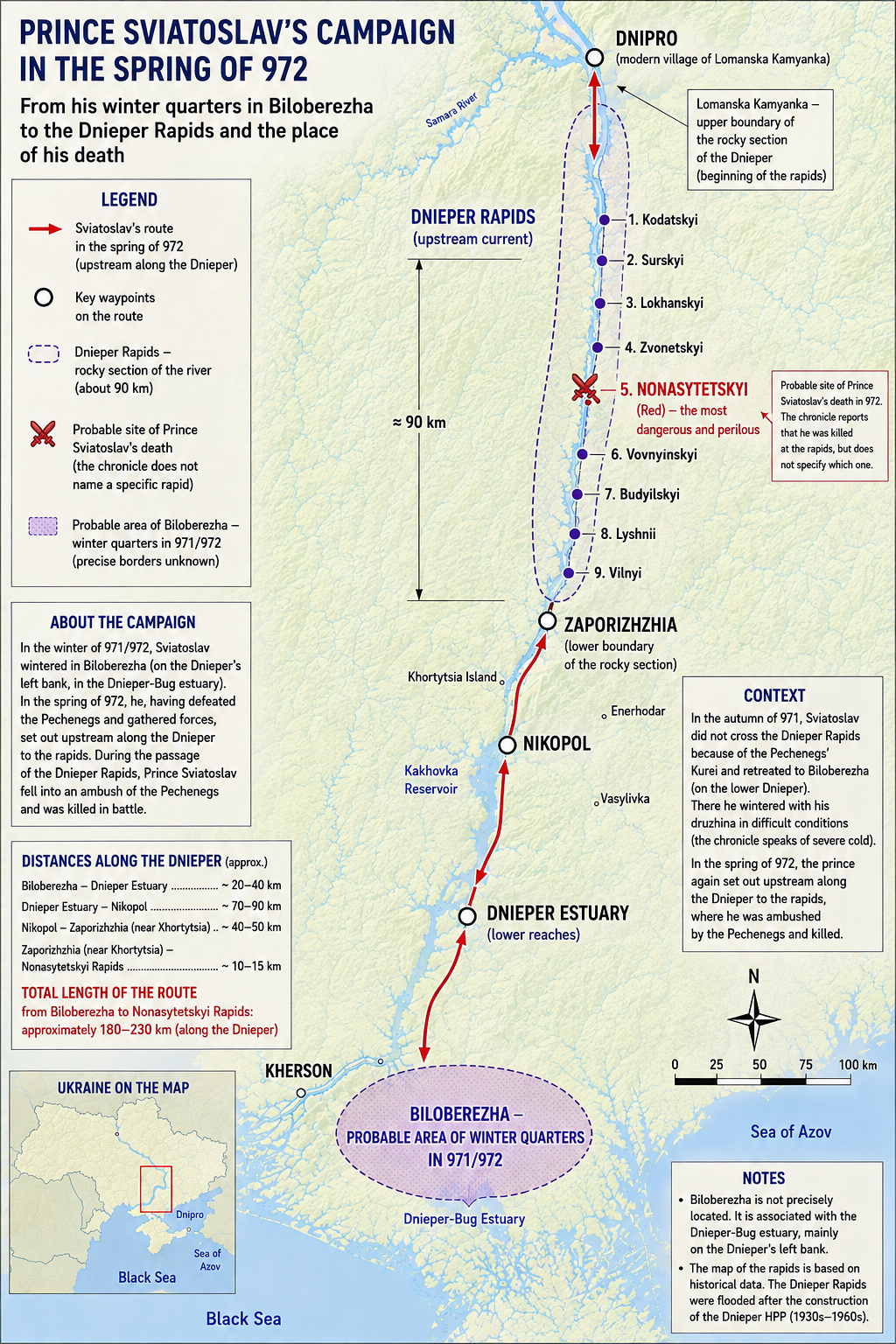
Why, then, not choose a completely different route in the spring? There are several reasons.
First, an alternative route meant leaving the Dnieper and entering the open steppe. For Sviatoslav, the river was not merely a road but the main transport artery carrying boats, weapons, possessions, and the remnants of his supplies. If he abandoned the boats and marched overland, his retinue would become a largely infantry or weakly mounted force in territory where the Pechenegs possessed an enormous mobility advantage. Constantine VII had already described this region in the mid-tenth century as an area in which the Rus were constantly exposed to Pecheneg attack.
Second, according to the chronicle tradition, Sveneld actually proposed another option — to travel on horseback, thereby bypassing the most dangerous river section overland. Sviatoslav refused. This is an important detail: the alternative existed not only in theory. But it was probably suitable for the most mobile part of the retinue and far less practical for an entire force that included boats, wounded men, booty, and equipment.
Sveneld eventually reached Kyiv. In hindsight, his decision therefore looks like the correct one. But Sviatoslav may have thought differently: if he abandoned the fleet, his possessions, and part of his men, this would no longer be an organized return of a prince with his retinue, but something close to a flight.
There was another problem. To “go around” the danger, one had to know where exactly to go. A modern observer sees a map of Ukraine with roads and settlements. In the tenth century, the enormous space between the lower Dnieper and the forest-steppe was politically and physically very different. The Pechenegs were nomads who could move rapidly across tens of kilometers, whereas a Rus force burdened with baggage and infantry would move much more slowly. A wide detour therefore might not have removed the threat at all; it could instead have given the Pechenegs the opportunity to pursue the column across terrain ideally suited to cavalry.
It is telling that Constantine VII described the passage through the Dnieper Rapids as an extremely vulnerable operation. At certain points the Rus had to leave their boats, guide or carry them, and post guards specifically because of the danger of Pecheneg attack.
But that raises an interesting question: why did Sviatoslav still go in the spring to the very place where he had already encountered the Pechenegs in the autumn? I think three factors probably combined.
The first was that hunger forced him to act. Remaining at the winter camp was no longer possible. The longer he waited, the weaker his retinue became.
The second was that he may have expected the Pechenegs to have already moved away. A nomadic army did not necessarily remain in the same place for half a year. It required enormous pasture resources for its horses. Sviatoslav could therefore reasonably have assumed that although the passage had been blocked in the autumn, the khan's detachments would disperse across the steppe after the winter.
The third factor, and in my view the most interesting, was Sviatoslav's own character as a commander. His earlier career had rewarded risk. For years he had solved problems by attacking: Khazaria, the Volga region, the Balkans, and the wars with Byzantium. Such military experience could easily create the belief that danger could be overcome through force and speed.
There is therefore a plausible psychological reconstruction: Sviatoslav may have believed that the previous autumn he had been stopped by unfavorable circumstances, not because the route itself was impassable. After the winter, he may have decided: this time we will break through.
And this is probably where Kurya outplayed him.
Back — toward the Black Sea and territories where Sviatoslav no longer had a reliable base;
west — across foreign lands after a lost war with Byzantium;
east — deeper into the Pecheneg steppe;
forward up the Dnieper — the shortest road to Kyiv, but through the rapids.
That is why the Dnieper, despite the danger, could still have appeared to be the least bad option.
There is another detail that is often underestimated. The Dnieper trade route was the familiar corridor between Kyiv and Byzantium. Alternative western river systems existed, but they were not a simple parallel road that one could join from the lower Dnieper. The Encyclopedia of Ukraine notes that the alternative system through the Pripyat, Bug, and Vistula gained greater importance later.
A detour was possible, but it would have meant completely changing the method of return: abandoning part of the fleet and possessions, finding horses, moving into the steppe or far to the west, and covering hundreds of additional kilometers with exhausted men.
The greatest mistake Sviatoslav made was probably not that he physically could not find another route. It was that he failed to use the alternative while he still had the strength to do so.
If, in the autumn of 971, he had listened to Sveneld, abandoned part of his possessions, and moved north with a mobile mounted detachment, his chances would probably have been considerably better. After the starving winter of 971/972, his choices had already narrowed to a set of very bad options.
And this produces an almost tragic sequence: in the autumn he was still strong enough to leave by another route but chose to wait; by spring he was weak enough to need the shortest route — and that was exactly where the Pechenegs were waiting for him.
Why Was the Ambush Site So Important?
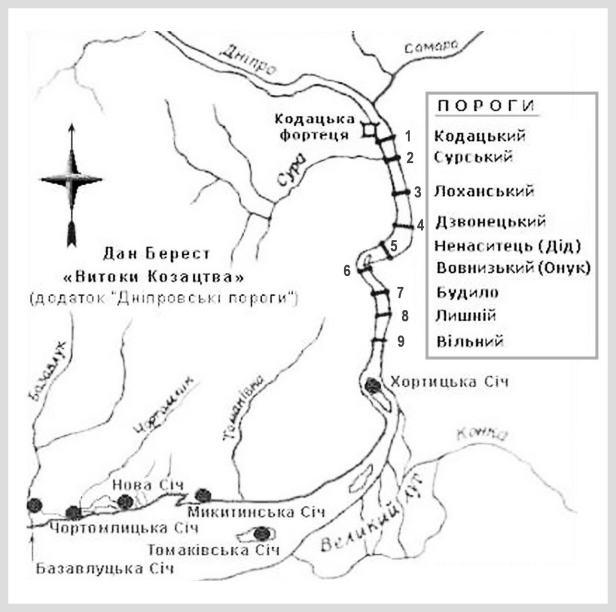
The Dnieper Rapids were not a single obstacle.
They were an entire belt of obstacles.
The Encyclopedia of Ukraine notes that the rapids seriously hindered transportation and required overland portages; it was precisely in this region that steppe nomads attacked Rus caravans.
This created an almost ideal military situation for Kurya.
He did not need to know exactly when Sviatoslav would arrive.
He only needed to know one thing:
if Sviatoslav was going to Kyiv by way of the Dnieper, he would eventually have to pass through this area.
This is a classic case of channeling an enemy's movement: geography itself forces him through a restricted corridor.
What I Would Have Done in Sviatoslav's Place
If we place ourselves specifically in the situation of autumn 971, rather than spring 972, my choice would have been the following:
1. Abandon the idea of bringing the entire fleet back to Kyiv.
The boats and booty should no longer have been the highest priority. The main objective was to preserve the prince and the core of the retinue.
2. Follow Sveneld's advice.
The most mobile men should leave on horseback.
3. Divide the force into several groups.
One large force is easier to detect. Several mobile groups could move along different routes and reunite farther north, beyond the steppe.
4. Do not try to defeat Kurya.
This is crucial.
The objective was not:
“defeat the Pechenegs.”
The objective was:
“avoid giving the Pechenegs a decisive battle and reach the forest-steppe.”
There the balance of advantages would begin to change. Forests, rivers, and settlements reduced the mobility of steppe cavalry, while Sviatoslav would be moving closer to his own resource base.
Where I See Sviatoslav's Possible Main Mistake
Not in the spring of 972.
In the autumn of 971.
When he first discovered that the Pechenegs had blocked the rapids, his army was probably in better condition than it would be after the winter.
That was the window of opportunity:
abandon part of the possessions → divide the army → obtain horses → move north together with Sveneld.
But Sviatoslav chose to wait.
In ordinary military logic, the decision is understandable:
“They are holding the passage now. Winter will come and they will disperse. We will get through in the spring.”
But the winter:
did not strengthen Sviatoslav — it exhausted him.
According to the chronicle tradition, the winter camp suffered from a severe shortage of food.
By spring, the situation may therefore have looked like this:
staying is impossible → returning to Byzantium makes no sense → a long march across the steppe is dangerous → the shortest way home is the Dnieper.
Sviatoslav makes one final attempt.
And Kurya already knows where he has to pass.
Three Possible Scenarios for the Balance of Forces
Since we do not have precise figures, it is more reasonable to consider several possibilities.
Scenario One — the Pechenegs had a major numerical advantage. Kurya may have had two or three times as many warriors. In this case Sviatoslav's defeat is relatively easy to explain: the enemy's numerical superiority was reinforced by greater mobility and favorable terrain. The problem with this version is that no source confirms such a ratio.
Scenario Two — the forces were approximately equal. This seems entirely plausible. Even with similar numbers, geography and the condition of Sviatoslav's retinue gave Kurya a substantial effective advantage.
Scenario Three — Kurya had fewer men. At first this seems paradoxical, but it cannot be ruled out. If the Pechenegs attacked a stretched-out column piece by piece, they did not need to outnumber Sviatoslav's entire force at the same time.
How the Final Battle May Have Unfolded
Let us imagine a possible sequence of events without presenting reconstruction as established fact.
In the spring of 972, the remnants of Sviatoslav's retinue begin moving up the Dnieper.
Pecheneg scouts detect them.
The information is passed to Kurya.
The khan does not rush into an open battle.
Sviatoslav continues moving and approaches a section where the boats have to slow down or be guided with particular care.
The column stretches out.
Then the attack comes.
The first clashes may occur simultaneously at several points.
Part of the retinue tries to regroup around the prince.
Experienced warriors form a center of organized resistance.
If the Rus manage to form up, the Pechenegs have no need to launch an immediate frontal assault.
It would be far more effective to use missile weapons, maneuver, attack from different directions, and prevent separate groups of the retinue from joining together.
As casualties increase, the formation begins to break apart.
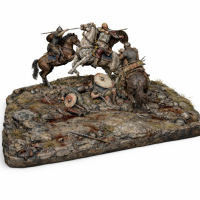
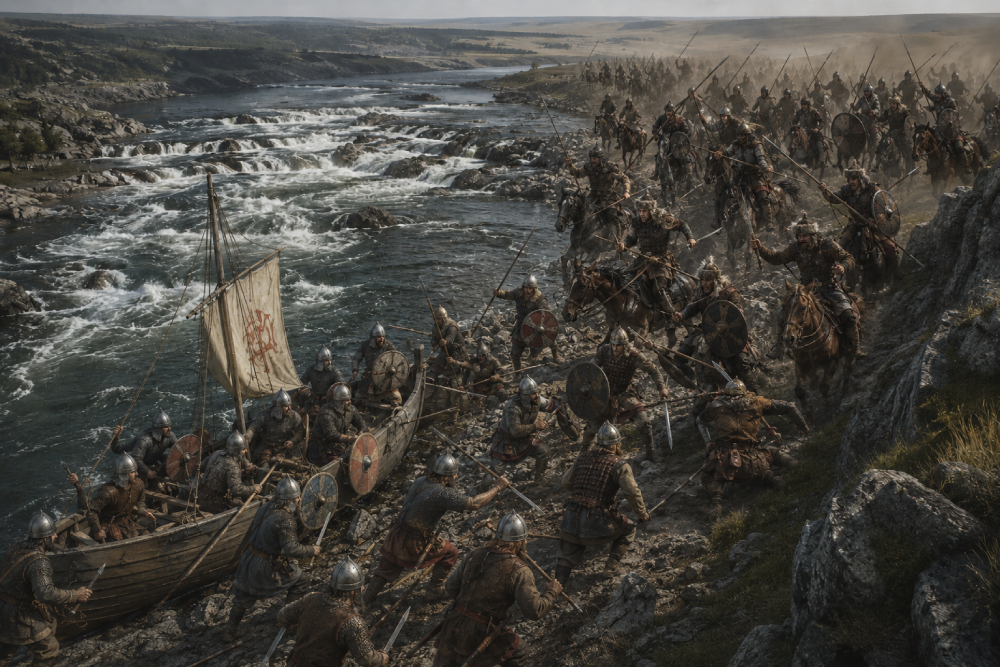
The mobile battle then turns into a series of close-range clashes.
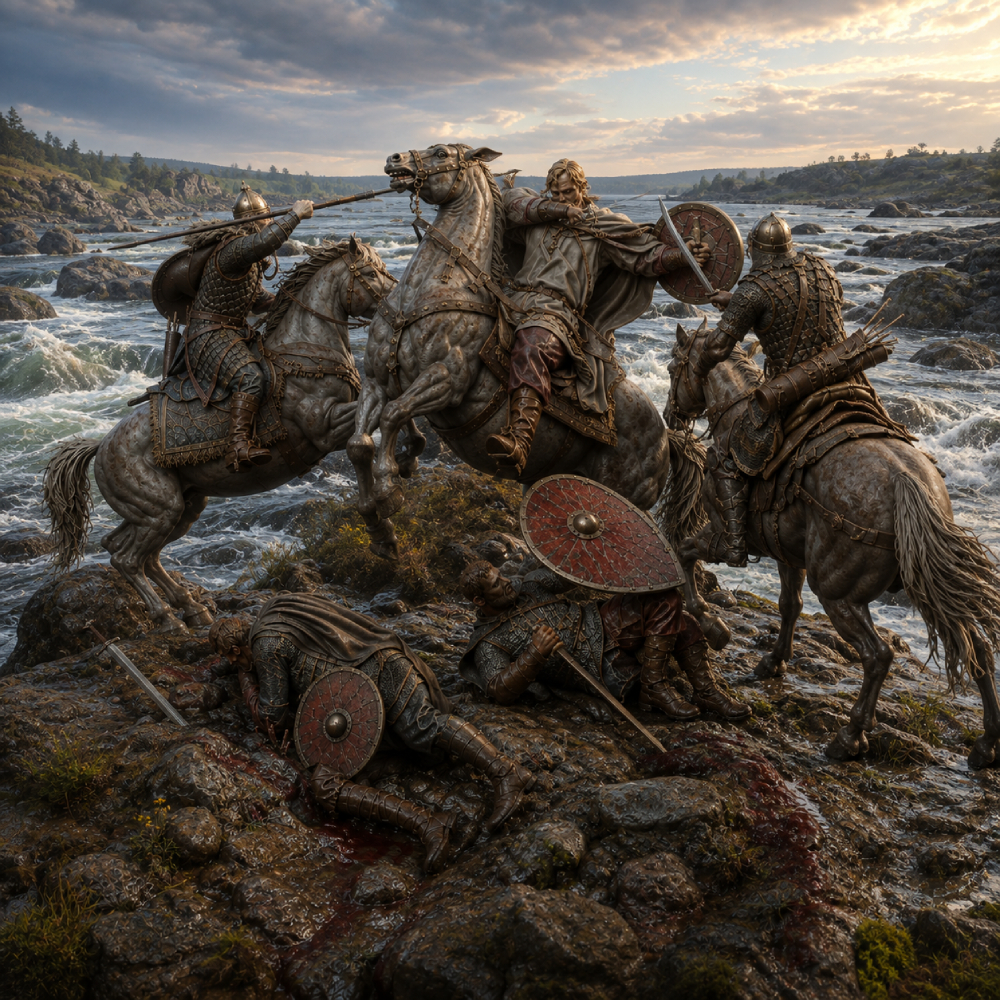
And in one of them, Sviatoslav fights his final battle.
Once again: the sources have not preserved a detailed account of this battle. This is a military-historical reconstruction of a possible scenario, based on the positions of the two sides and the nature of the terrain.
Why Was Sviatoslav Himself Killed?
Here another important factor appears.
For the retinue, the prince was not merely its commander.
Sviatoslav was the center of the entire military structure of the force. His death could cause a psychological and organizational collapse even among experienced warriors.
Therefore, if Kurya or his commanders understood where the prince was positioned, destroying the princely group itself would have been an especially important objective.
After Sviatoslav's death, organized resistance may have rapidly fragmented into isolated pockets.
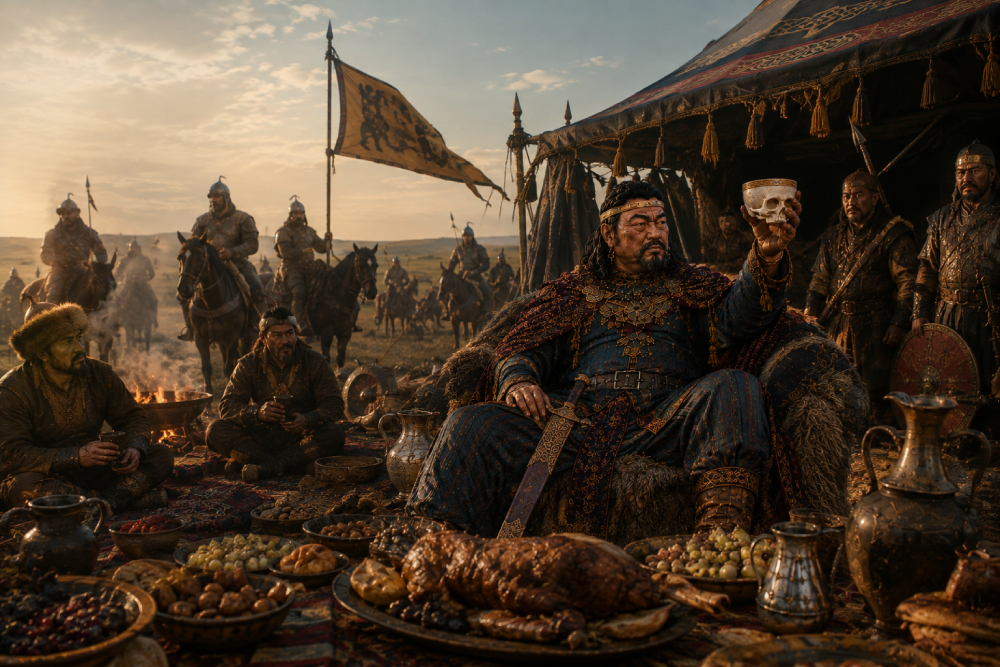
At the same time, the chronicle report that Khan Kurya later made a drinking cup from Sviatoslav's skull, regardless of how historically accurate this detail may be, demonstrates the enormous symbolic significance that the tradition attached to the personality of the defeated prince.
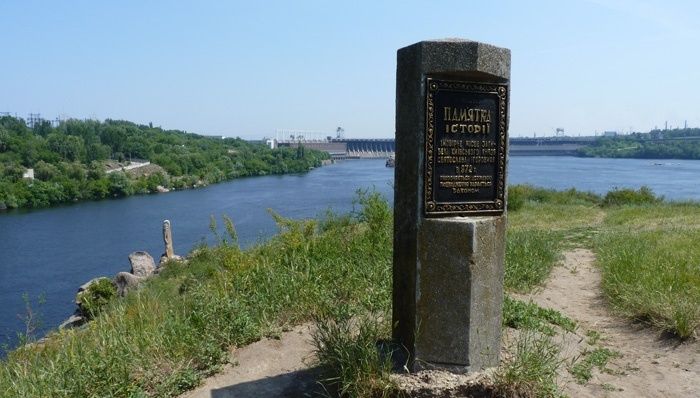
Where Did Prince Sviatoslav Die?
Version No. 1 — The Nenasytets Rapid
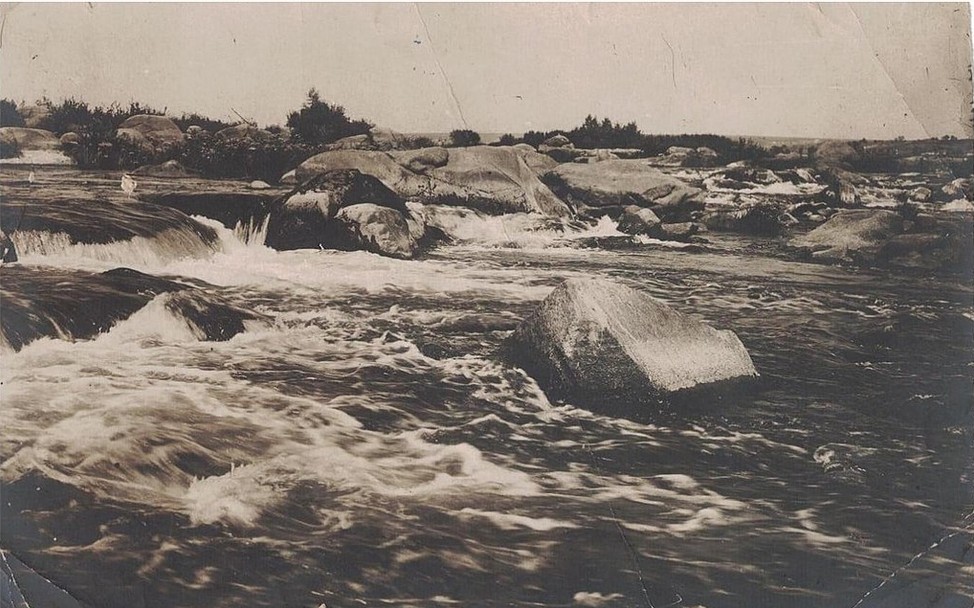
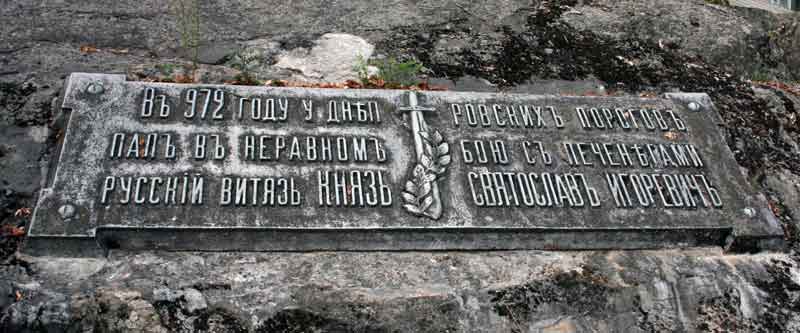
One of the best-known proposed locations is the area of the Nenasytets Rapid (Nenasytets, Nenasyteць), the largest and one of the most dangerous of the Dnieper Rapids.
Version No. 2 — The Khortytsia Area
Another very widespread theory places the site in the area of Khortytsia Island, considerably farther downstream.