.png "HistorSTL — STL Files for 3D Printing Historical Miniatures: Warriors & Military Models")
Battle of Batih 1652: Khmelnytsky’s Decisive Victory and the Story of the Battle
```htmlThe Battle of Batih became one of the most famous clashes of the era of Bohdan Khmelnytsky. On June 1–2, 1652, near Mount Batih and not far from the Southern Bug River, Cossack and Crimean Tatar forces confronted the army of the Polish–Lithuanian Commonwealth commanded by Field Crown Hetman Marcin Kalinowski.
The battle ended in a crushing defeat for Kalinowski’s army and significantly changed the military and political situation after the unsuccessful Cossack campaign of 1651.
But why did the Polish army find itself in such a dangerous position, and how did Khmelnytsky’s forces manage to achieve such a decisive victory?
What Led to the Battle of Batih
After the campaign of 1651 and the signing of the Treaty of Bila Tserkva, the conflict between the Zaporozhian Host and the Polish–Lithuanian Commonwealth did not end.
In the spring of 1652, tensions escalated once again.
One of the immediate causes was the campaign of Tymish Khmelnytsky toward Moldavia. Marcin Kalinowski attempted to block his route and positioned his forces near Mount Batih.
The location seemed suitable for defense, but during the battle the size and position of the camp became a serious disadvantage.
Where Did the Battle of Batih Take Place?
The battle took place in the area of Mount Batih in the Bratslav region, not far from the Southern Bug River.
Marcin Kalinowski’s army established a large camp in terrain partly restricted by natural obstacles.
A large camp could be an advantage if defended by sufficient forces, but an extended defensive perimeter required a considerable number of troops.
Bohdan Khmelnytsky was able to exploit this weakness.
Forces Involved
It is difficult to establish the exact size of the armies today, as historical estimates differ considerably.
Khmelnytsky’s army included Cossack regiments as well as significant forces of Crimean Tatar cavalry.
They faced the army of the Polish–Lithuanian Commonwealth under Marcin Kalinowski, which included cavalry, infantry, and other formations.
The Battle of Batih should therefore not be understood as a small force attacking an enormous army. It was a major military operation involving thousands of soldiers from different branches of service.
How the Battle of Batih Unfolded
The fighting lasted for two days, June 1 and 2, 1652.
Cossack and Crimean Tatar forces attacked Kalinowski’s positions and gradually increased pressure on the camp.
The second day became decisive.
The defense began to collapse, disorder spread inside the camp, and the possibility of an organized retreat became increasingly limited.
As a result, the army of the Polish–Lithuanian Commonwealth suffered a devastating defeat.
Marcin Kalinowski was killed.
The battle ended in a complete victory for Bohdan Khmelnytsky’s army and became one of the most significant military successes of the Cossack forces during the uprising.
Why Did Khmelnytsky Win at Batih?
The victory cannot be explained by a single factor.
Several important circumstances came together:
the unfavorable location and excessive size of the enemy camp;
effective cooperation between Cossack units and Crimean Tatar cavalry;
the initiative of Khmelnytsky’s command;
pressure on enemy positions from several directions;
command and control problems inside the camp.
As a result, Kalinowski’s army was unable to use all of its forces effectively or maintain a stable defense.
Why the Battle of Batih Became Historically Important
The victory had significance far beyond the battlefield.
After the difficult campaign of the previous year, it demonstrated that Bohdan Khmelnytsky’s army still had the ability to conduct major offensive operations.
Batih also became an example of how quickly the outcome of a seventeenth-century battle could change once military organization broke down and control over a fortified camp was lost.
For historians, modelers, and military history enthusiasts, the battle is also fascinating because of the variety of forces involved.
Cossacks, Crimean Tatar cavalry, Polish cavalry and infantry, along with the weapons and clothing of the mid-seventeenth century, make it possible to reconstruct not only individual warriors but an entire historical scene.
The Battle of Batih in Miniature
The history of the battle can be studied through books, maps, and historical documents. But a historical miniature allows the event to be experienced in a completely different way.
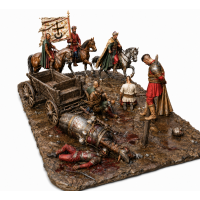
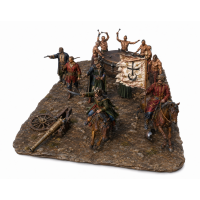
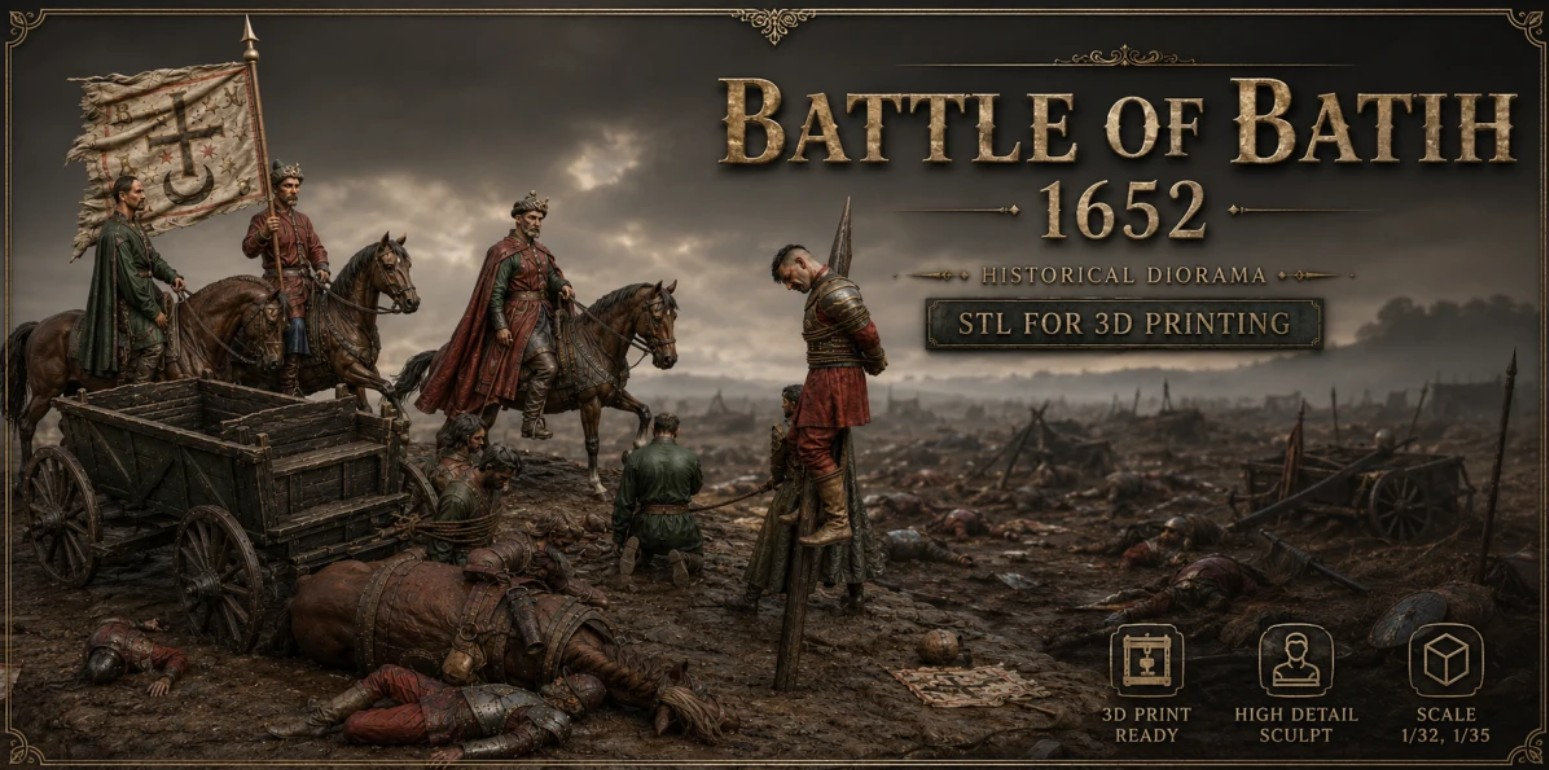
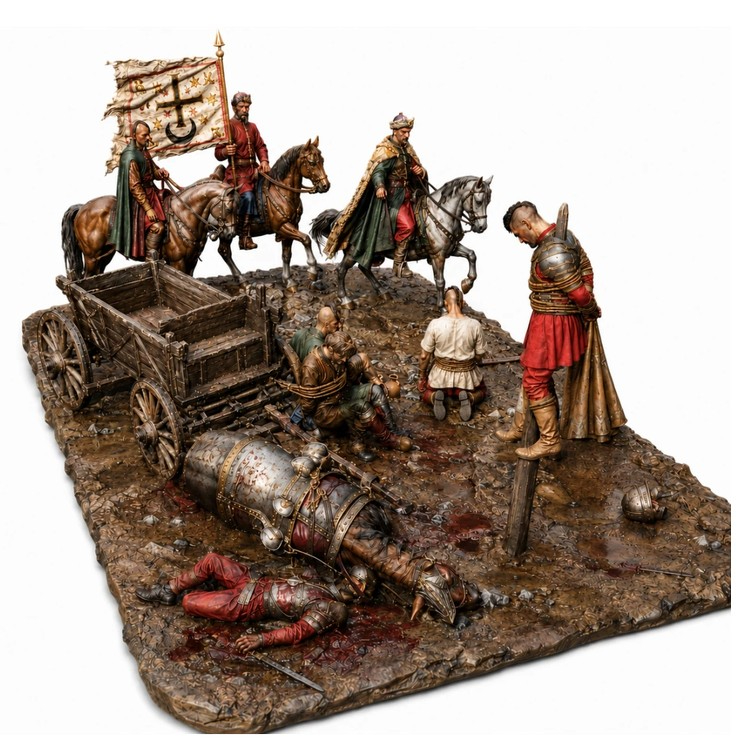
This idea inspired the Battle of Batih 1652 3D Diorama by HistorSTL .
The composition depicts a dramatic episode following the battle, with warriors, horses, weapons, terrain elements, and numerous small details combined into a single historical scene.
This is not a finished physical model shipped by mail. It is a digital STL project for 3D printing.
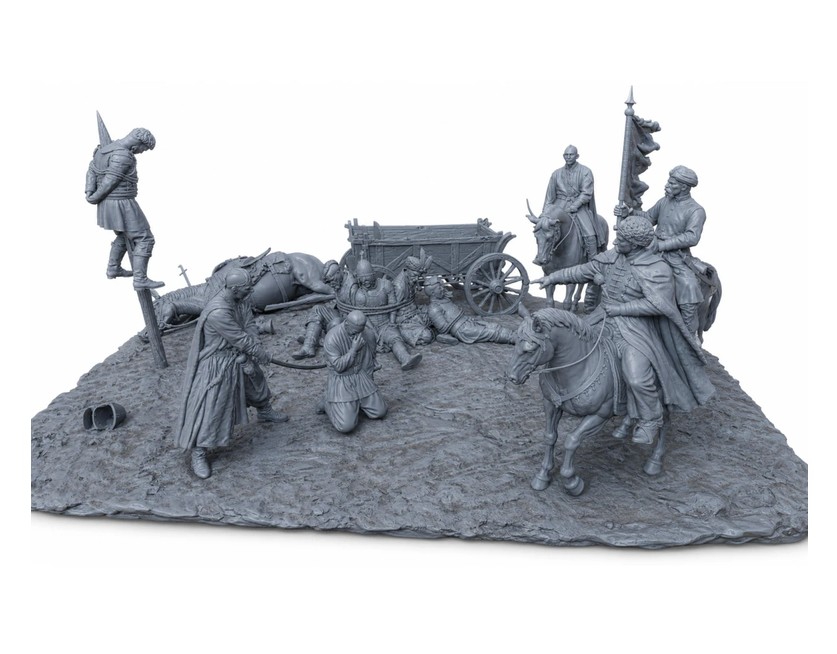
Battle of Batih 1652 — STL Diorama for 3D Printing
Digital STL Files • Instant Download • Designed for Resin Printing
Who Is This Diorama For?
The model was created primarily for historical miniature enthusiasts and 3D printing hobbyists.
It can be used for:
building a historical diorama;
a seventeenth-century miniature collection;
miniature painting;
museum or educational displays;
showcasing the capabilities of resin 3D printing;
a personal project dedicated to the Cossack era.
After printing, the individual parts can be cleaned, assembled, and painted, turning the digital model into a complete physical composition.
What You Receive
After purchase, you receive digital STL files for your own 3D printing.
The files become available for download after payment, so there is no need to wait for physical delivery.
For the highest level of detail in historical miniatures like this one, printing on a resin 3D printer is recommended.
View all images, explore the model details, and purchase the STL files:
→ Battle of Batih 1652 — Historical STL Diorama for 3D Printing
History You Can Print
The Battle of Batih took place more than three and a half centuries ago, yet interest in it remains strong today.
For some, it is an important episode in seventeenth-century military history. For others, it is a source for studying the weapons, clothing, and appearance of soldiers of the period. For a modeler, it offers the opportunity to literally build a historical scene with their own hands.
3D printing brings these interests together.
Instead of viewing a picture on a screen or reading a page in a book, you can create a three-dimensional composition that can be examined from different angles, painted, and used as the centerpiece of your own historical project.
If you would like to recreate an episode of seventeenth-century Cossack history in miniature, explore the “Battle of Batih 1652” diorama and prepare it for printing on your own 3D printer.

$9.99 $14.99